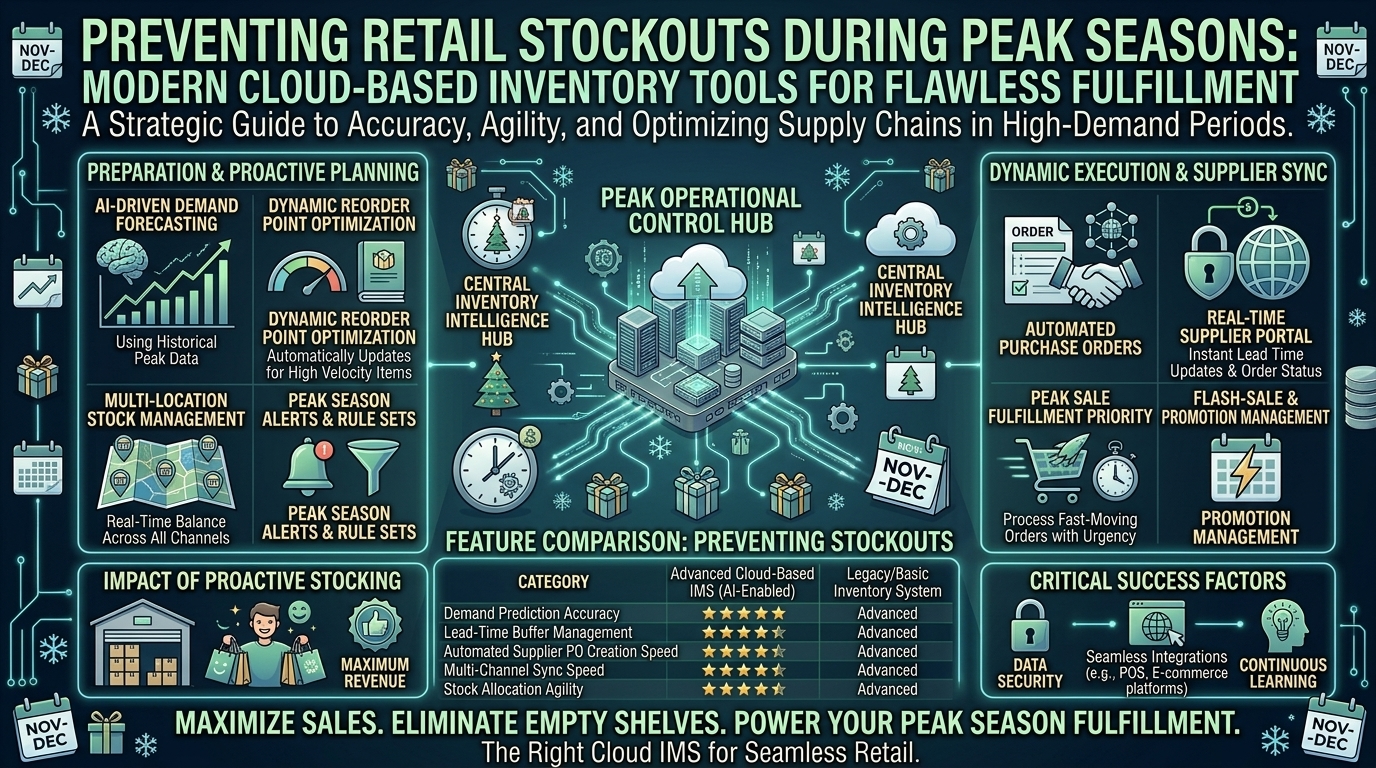
For modern retail business owners, the final quarter of the year—or major promotional blitzes like Black Friday, Cyber Monday, and regional holiday surges—can dictate whether an entire fiscal year ends in profit or loss. Whether running a high-growth ecommerce brand in San Francisco, managing brick-and-mortar storefronts across New York and California, or coordinating distribution hubs in Texas and Washington, encountering a stockout during a peak sales surge represents a catastrophic failure of logistics.
When a high-demand item goes out of stock, the consequences ripple far beyond a single lost transaction:
- Immediate Revenue Loss: Customers thwarted by an “Out of Stock” notice rarely wait; they instantly pivot to a competitor.
- Wasted Marketing Expenditure: Driving expensive paid traffic via digital ads to a product page that cannot fulfill orders burns capital with zero return.
- Long-Term Customer Churn: Modern shoppers have little patience for fulfillment failures. A disappointed buyer during a holiday rush is unlikely to return.
Historically, retailers relied on static spreadsheets, manual warehouse counts, and gut-feeling purchasing estimates. In today’s hyper-accelerated retail environment, these legacy methods guarantee supply chain failure. Modern cloud-based inventory management tools have revolutionized this space, offering real-time data synchronization, predictive analytics, and automated multi-channel orchestration. This guide explores how cloud inventory platforms empower retailers to eliminate stockouts completely during their busiest seasons.
1. The Core Vulnerability: Why Traditional Systems Fail During Peak Surges
Before evaluating how cloud-based tools solve inventory crises, it is critical to understand why legacy, on-premise, or manual systems collapse under seasonal pressure.
+--------------------------+------------------------------------+---------------------------------------+
| System Type              | Data Update Frequency              | Peak Season Vulnerability             |
+--------------------------+------------------------------------+---------------------------------------+
| Manual Spreadsheets      | Periodic / End-of-Day manual entry | High human error, massive lag times   |
| On-Premises Legacy ERP   | Periodic batch syncs               | Siloed data, crashes under high loads |
| Cloud-Based SaaS Platform| Continuous / Real-Time             | Infinite scalability, live sync       |
+--------------------------+------------------------------------+---------------------------------------+
The Multi-Channel Silo Problem
Modern retailers rarely sell through just one channel. A typical brand lists products on their proprietary e-commerce storefront (Shopify, WooCommerce, Magento), major online marketplaces (Amazon, Walmart), social commerce platforms (TikTok Shop, Instagram), and physical brick-and-mortar registers (POS systems).
If these channels operate on disconnected inventory counts, a sudden surge of 50 orders on Amazon can quietly deplete stock that was simultaneously being sold at a physical pop-up shop in downtown Manhattan or Los Angeles, resulting in severe overselling and forced cancellations.
2. How Cloud-Based Systems Prevent Stockouts: 5 Pillars of Technology
Cloud inventory management software (such as Cin7 Core, Katana, NetSuite, and Zoho Inventory) prevents stockouts through a combination of live data architectures and automated workflows.
A. Real-Time Multi-Channel Inventory Syncing
Cloud platforms act as a centralized digital nervous system. The moment an item is purchased on any connected sales channel, the central cloud database updates instantly across every other integrated storefront. If inventory drops to a pre-set threshold, the system can automatically throttle marketing ads for that specific item or update website badges to reflect low-stock urgency without human intervention.
B. Predictive Demand Forecasting and AI-Driven Analytics
Relying solely on historical sales from the previous year is dangerous because market trends shift rapidly. Modern cloud tools leverage machine learning algorithms and predictive analytics to examine multi-variable data points:
- Macroeconomic and Regional Trends: Factoring in regional buying habits across different commercial footprints (e.g., consumer demand shifts unique to Texas versus Washington).
- Marketing Campaign Schedules: Integrating upcoming email marketing blasts, influencer campaigns, or paid ad budgets directly into the inventory forecast to calculate expected demand spikes.
- Lead Time Variability: Tracking supplier shipping delays in real time to dynamically adjust when purchase orders must be dispatched.
C. Automated Reorder Points and Safety Stock Calculations
Human managers easily forget to reorder inventory when overwhelmed by peak season chaos. Cloud inventory software utilizes automated Reorder Points (ROP) based on the formula:
$$\text{Reorder Point} = (\text{Average Daily Sales} \times \text{Lead Time}) + \text{Safety Stock}$$
When inventory dips to this mathematical threshold, the system automatically drafts or dispatches a Purchase Order (PO) to the supplier, ensuring stock replenishment occurs before shelves run dry.
D. Distributed Inventory and Multi-Warehouse Visibility
For growing brands operating distribution centers across multiple regions (such as bi-coastal fulfillment hubs in New York and California), cloud platforms provide total visibility into stock locations. If a local fulfillment center runs low on a hot-selling item, the system can automatically reroute online orders to a neighboring warehouse with surplus stock or initiate an internal stock transfer before a stockout occurs.
E. Supplier Portal Integration and Lead Time Tracking
A stockout is frequently caused upstream by tardy suppliers. Cloud inventory management tools often include vendor portals that track historical supplier performance, monitoring fulfillment speed, defect rates, and shipping delays. This transparency allows business owners to identify unreliable suppliers months before peak season hits and pivot to backup manufacturers.
3. Step-by-Step Peak Season Preparation Playbook for Retailers
Deploying software alone is not enough; retail business owners must follow a disciplined operational timeline to bulletproof their supply chain ahead of high-volume sales periods.
+-----------------------------+------------------------------------+---------------------------------------+
| Timeline Phase              | Primary Operational Focus          | Key Cloud System Action               |
+-----------------------------+------------------------------------+---------------------------------------+
| 6 Months Prior              | Historical Audit & Demand Modeling | Analyze past peak data & clean SKUs   |
| 3 Months Prior              | Supplier POs & Buffer Stock        | Set automated ROPs & safety buffers   |
| 1 Month Prior               | Multi-Channel Sync Stress Test     | Verify real-time API sync across POS  |
| Live Peak Season            | Real-Time Monitoring & Rerouting   | Track live velocity & adjust ads      |
+-----------------------------+------------------------------------+---------------------------------------+
- Audit and Clean Your SKU Database: Eliminate “ghost inventory” (damaged, lost, or dead stock sitting in corners) by conducting a full cycle count and syncing physical counts with your cloud platform.
- Establish Dynamic Safety Stock Buffers: Increase safety stock parameters by 15% to 25% for high-velocity items during peak quarters to absorb unexpected viral demand spikes.
- Run Integration Stress Tests: Test API connections between your e-commerce platform, 3PL (Third-Party Logistics) provider, and cloud inventory software to ensure high-volume order surges will not cause data bottlenecks or sync delays.
4. Comprehensive Frequently Asked Questions (FAQ)
1. What is a stockout, and why is it so damaging during peak retail seasons?
A stockout occurs when a retail business runs completely out of inventory for a specific product while customer demand still exists. During peak seasons, stockouts destroy immediate revenue, waste marketing ad spend, and drive frustrated customers directly into the arms of competitors.
2. How do cloud-based inventory tools differ from traditional spreadsheets?
Spreadsheets rely on manual data entry, are prone to human error, and update statically. Cloud-based inventory tools sync in real time across all sales channels, automatically update stock levels when items sell, predict future demand using data analytics, and trigger automated reorders.
3. Can cloud inventory software prevent overselling across multiple online marketplaces?
Yes. By centralizing inventory control, if a product is purchased on Amazon, Shopify, or an in-store POS terminal, the cloud system instantly subtracts that unit from the total pool across all connected channels within seconds.
4. What is a “reorder point,” and how do cloud systems calculate it?
A reorder point is the exact inventory level that triggers a replenishment order. Cloud systems calculate this automatically by multiplying your average daily product sales velocity by the supplier’s shipping lead time, plus an extra buffer of safety stock.
5. How do predictive forecasting tools handle unexpected viral trends?
Advanced cloud platforms utilize machine learning to monitor real-time sales velocity anomalies. If an item starts selling three times faster than normal, the algorithm flags the acceleration and alerts managers or automatically adjusts upcoming purchase order recommendations.
6. Do small boutique retailers with a single store need cloud inventory software?
Even single-location retailers benefit immensely. Cloud software replaces manual counting with barcode scanning, tracks profit margins accurately, syncs physical store sales with an online webshop, and prevents sudden out-of-stock surprises during holiday rushes.
7. What role do third-party logistics (3PL) providers play in cloud inventory management?
Cloud inventory software integrates directly with 3PL warehouse management systems. This gives retail owners real-time visibility into exact stock levels sitting in external fulfillment warehouses without needing to make phone calls or request manual spreadsheets.
8. How do I handle slow-moving stock that ties up capital during peak season?
Cloud inventory dashboards feature aging reports that highlight slow-moving or dead stock. Identifying these items early allows retailers to bundle them or run targeted promotions to free up valuable warehouse storage space for high-demand peak season goods.
9. Are my business and customer data secure in a cloud inventory platform?
Yes. Top-tier cloud inventory providers utilize enterprise-grade 256-bit encryption, multi-factor authentication (MFA), role-based access controls, and redundant cloud servers (such as AWS or Google Cloud) to ensure high availability and data security.
10. How long does it take to migrate from spreadsheets to a cloud inventory system?
Migration timelines depend on catalog size and SKU complexity, ranging anywhere from a few days for small boutiques to 4 to 6 weeks for enterprise multi-warehouse operations. Most platforms offer dedicated onboarding support to assist with data migration.
Conclusion
Preventing stockouts during high-stakes peak selling seasons is no longer a matter of guesswork; it is a discipline driven by real-time data, automation, and predictive technology. By adopting modern cloud-based inventory management tools, retail business owners eliminate the blind spots caused by multi-channel data silos and manual spreadsheets. Whether scaling a digital storefront in San Francisco, managing boutique storefronts in New York, or coordinating sprawling distribution networks across Texas, Washington, and California, cloud inventory integration ensures your shelves stay stocked, your customers stay loyal, and your business maximizes peak revenue potential.
Leave a Reply