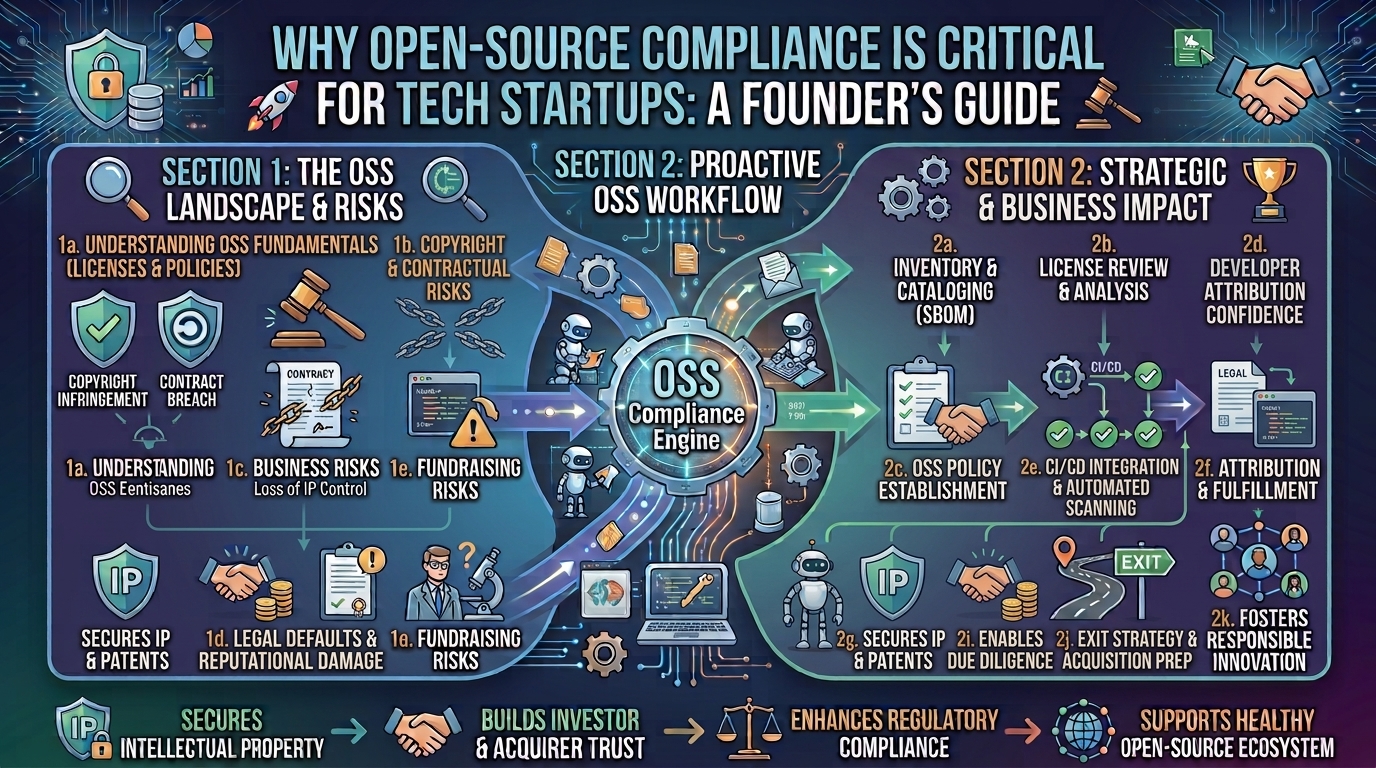
For modern tech startup founders launching innovative products across the United Kingdom, Europe, and major US tech hubs—from the venture-backed incubators of San Francisco and the digital engineering networks of California, to the corporate legal powerhouses of New York, the federal and cloud standard bearers of Washington, and the rapidly expanding enterprise ecosystems of Texas—building software from scratch is virtually extinct.
No modern engineering team writes every line of code for a commercial application. Instead, startup velocity relies heavily on Open-Source Software (OSS). By leveraging pre-built open-source libraries, frameworks, packages, and modules (such as those hosted on npm, PyPI, Maven, and GitHub), engineering teams can bring a minimum viable product (MVP) to market in months rather than years.
However, this reliance on open source comes with a major catch. Open-source software is free to use, but it is not free of legal obligations.
Far too many startup founders treat open-source components like public domain software, dropping them into proprietary commercial codebases without tracking their licenses. This oversight creates a ticking legal and financial time bomb. When venture capital (VC) firms conduct due diligence ahead of a funding round, or when enterprise clients audit vendor codebases, unaddressed open-source license violations can stall acquisitions, devalue valuations, or result in catastrophic copyright infringement lawsuits.
This comprehensive guide explores the complexities of open-source compliance, the risks of non-compliance, and actionable steps startup founders must take to protect their commercial applications.
1. Deconstructing Open-Source Licenses: The Spectrum of Freedom
When an author releases software under an open-source license, they grant users the right to view, modify, and distribute the source code. However, these rights are granted conditionally. The conditions are defined by the specific license attached to the software.
Broadly speaking, open-source licenses fall into two main categories: Permissive Licenses and Copyleft Licenses.
+-------------------------------------------------------------------------+
|                    THE OPEN-SOURCE LICENSE SPECTRUM                     |
+------------------------------------+------------------------------------+
| PERMISSIVE LICENSES                | COPYLEFT LICENSES                  |
| (MIT, Apache 2.0, BSD)             | (GPL, AGPL, LGPL)                  |
| • Minimal restrictions             | • Viral propagation requirements   |
| • Keep copyright notice            | • Must open source modifications   |
| • Safe for commercial close-source | • High risk for proprietary IP     |
+------------------------------------+------------------------------------+
A. Permissive Licenses (The Startup-Friendly Route)
Permissive licenses (such as the MIT License, Apache 2.0 License, and BSD Licenses) impose minimal requirements on developers.
- The Rules: You can use, modify, distribute, and even rebrand the software into a closed-source, proprietary commercial product. The only typical requirements are retaining the original copyright notice and license text somewhere in your documentation or application notices.
- Commercial Impact: Highly friendly to startups seeking to protect proprietary intellectual property (IP).
B. Copyleft Licenses (The Commercial Danger Zone)
Copyleft licenses (such as the General Public License (GPL), GNU Lesser General Public License (LGPL), and the dreaded Affero General Public License (AGPL)) are built on a philosophy of keeping software perpetually open.
- The “Viral” Nature: Copyleft licenses operate on a reciprocity principle. If you link your proprietary commercial code with a GPL-licensed library and distribute or deploy that application, your proprietary source code may also become legally subject to the GPL, forcing you to open-source your entire commercial codebase to the public for free.
- Commercial Impact: Can instantly destroy a startup’s proprietary business model if unmanaged.
2. Why Open-Source Compliance Matters for Venture Capital and Acquisitions
Founders often ask: “We are a tiny startup with ten users; who is going to check our open-source licenses?”
The answer becomes glaringly obvious the moment your startup achieves traction, seeks institutional funding, or enters acquisition talks.
The Institutional Due Diligence Audit
When a VC firm in San Francisco or New York considers investing millions of dollars into your Series A round, or when a tech giant looks to acquire your startup, they do not just look at your user growth metrics. They run a rigorous codebase IP audit (often using specialized software composition analysis tools).
If the audit reveals that your core commercial proprietary application is contaminated with viral AGPL code, the deal can instantly collapse or face massive valuation write-downs. Investors will not risk inheriting massive copyright infringement liabilities or being forced to open-source their investment.
3. Regional Perspectives: Legal Landscapes and Enterprise Expectations
Different commercial regions enforce software IP compliance through distinct regulatory and corporate lenses:
New York: Financial Software and Corporate Governance
New York financial technology (FinTech) and enterprise software firms operate under strict corporate governance and compliance frameworks. Financial institutions purchasing software vendors demand absolute transparency regarding code provenance to ensure no copyright infringement threatens their internal systems.
San Francisco & Silicon Valley: Intellectual Property as Core Valuation
In the capital of venture capital and software innovation, IP is a startup’s primary asset. Bay Area investors scrutinize open-source compliance from day one, knowing that clean code ownership is essential for patenting technology and securing clean exits.
Texas: Enterprise Software and Industrial Convergence
Spanning massive enterprise software vendors, healthcare tech companies, and industrial tech innovators in Texas, compliance with third-party software terms prevents costly breach-of-contract lawsuits from enterprise clients who demand indemnity against intellectual property claims.
California (Southern California & Digital Media): SaaS and Consumer Platforms
Los Angeles and Silicon Beach digital media platforms rely heavily on rapid software deployment. Founders here must balance rapid iteration with strict license tracking to prevent consumer-facing SaaS applications from leaking proprietary codebases.
Washington: Federal Contracting and Cloud Standards
Washington enterprises and government contractors must comply with stringent federal procurement rules and software bill of materials (SBOM) mandates. Managing open-source compliance is a non-negotiable prerequisite for supplying software to federal agencies.
4. The Anatomy of an Open-Source Violation
How do startups accidentally violate open-source licenses? It usually happens through routine engineering practices:
- Unvetted Package Manager Imports: A developer installs an npm package to solve a quick formatting problem without checking its license header. That package relies on three sub-packages, one of which carries a restrictive AGPL license.
- Ignoring Attribution Requirements: Using an MIT-licensed database connector in a commercial app without including the mandatory copyright notice in the app’s “About” or legal notices screen.
- The SaaS Loophole and the AGPL: Founders often assume that because their software is delivered as a cloud-based Software-as-a-Service (SaaS) rather than distributed as a downloadable binary, copyleft rules don’t apply. The AGPL specifically closes this loophole, dictating that if users interact with the software over a network, the source code must be made available to them.
5. Step-by-Step Compliance Roadmap for Startup Founders
Founders do not need to become intellectual property lawyers, but they must establish a proactive compliance culture from day one:
[ Step 1: Adopt an Open-Source Policy ] ---> [ Step 2: Implement SCA Tools ] ---> [ Step 3: Maintain an SBOM ] ---> [ Step 4: Regular Legal Review ]
Step 1: Establish a Clear Open-Source Usage Policy
Draft a simple internal policy for your engineering team. Categorize approved licenses (e.g., MIT, Apache 2.0, BSD are pre-approved; GPL, AGPL, and custom restrictive licenses require explicit CTO or legal review before installation).
Step 2: Automate Scanning with Software Composition Analysis (SCA)
Do not rely on manual code reviews. Integrate automated Software Composition Analysis (SCA) tools (such as Snyk, Black Duck, Mend, or GitHub Dependabot) directly into your continuous integration/continuous deployment (CI/CD) pipeline. These tools flag license risks the moment a developer tries to pull a restricted package.
Step 3: Maintain a Software Bill of Materials (SBOM)
An SBOM is a formal, structured inventory of all open-source and third-party components making up a software application. Maintaining an up-to-date SBOM is increasingly demanded by enterprise clients and federal regulators alike.
Step 4: Consult IP Legal Counsel Early
Spend a modest amount on startup-focused intellectual property counsel early on to draft your initial contributor license agreements (CLAs) and review your core software architecture before major funding rounds.
10 Frequently Asked Questions (FAQ)
1. What is open-source software compliance and why does it matter for startups?
Open-source compliance is the practice of ensuring that third-party open-source code used in a commercial application is utilized in strict accordance with its assigned copyright license. It matters because violating these licenses can lead to copyright infringement lawsuits, forced open-sourcing of proprietary code, and failed investor due diligence.
2. Can I legally use open-source software in a commercial, profit-making application?
Yes, absolutely. Millions of commercial applications rely on open-source software. However, your right to use it commercially depends entirely on the terms of the specific license attached to that software.
3. What is the difference between a permissive license and a copyleft license?
Permissive licenses (like MIT and Apache 2.0) allow you to use, modify, and close-source your code with minimal restrictions. Copyleft licenses (like GPL and AGPL) contain “viral” clauses that may legally require you to make your own proprietary commercial source code open-source if you distribute or deploy it.
4. What is the “viral” effect of the GNU General Public License (GPL)?
The viral effect refers to the requirement that any larger work combining GPL-licensed code with proprietary code must itself be licensed under the GPL terms when distributed, effectively stripping away proprietary intellectual property rights.
5. Does the AGPL apply if our software is delivered as a cloud SaaS product?
Yes. While traditional GPL is triggered by distribution of software binaries, the Affero GPL (AGPL) was specifically written to close the “SaaS loophole,” requiring source code disclosure if users interact with the modified software over a computer network.
6. How do venture capital firms check open-source compliance during due diligence?
VC firms and acquirers use automated Software Composition Analysis (SCA) tools to scan your source code repositories, identify every third-party library, and flag any license discrepancies or dangerous copyleft dependencies before approving funding or acquisitions.
7. What is a Software Bill of Materials (SBOM) and why do we need one?
An SBOM is a comprehensive inventory list detailing all components, libraries, and open-source packages utilized inside a software build. It is vital for security vulnerability management and proving compliance to enterprise clients and auditors.
8. What automated tools can startups use to track open-source licenses?
Startups commonly use developer-friendly Software Composition Analysis (SCA) tools such as Snyk, GitHub Dependabot, Mend (formerly WhiteSource), and Black Duck to automatically monitor and flag license risks in real-time.
9. What should a startup do if they discover a copyleft license violation in their code?
If a restricted package is discovered, the engineering team must refactor the code to remove or replace the library with a permissively licensed or custom alternative, followed by a clean rebuild and audit verification.
10. When should a startup founder consult an intellectual property attorney regarding OSS?
Founders should consult IP legal counsel before commercializing their MVP, when setting up internal engineering guidelines, and immediately before entering institutional fundraising rounds or acquisition discussions.
Conclusion: Build Fast, But Build Legally Compliant Code
Open-source software is the lifeblood of modern tech innovation. It allows startup founders in San Francisco, New York, Texas, Washington, California, and around the globe to build sophisticated commercial applications with unprecedented speed and efficiency.
Leave a Reply