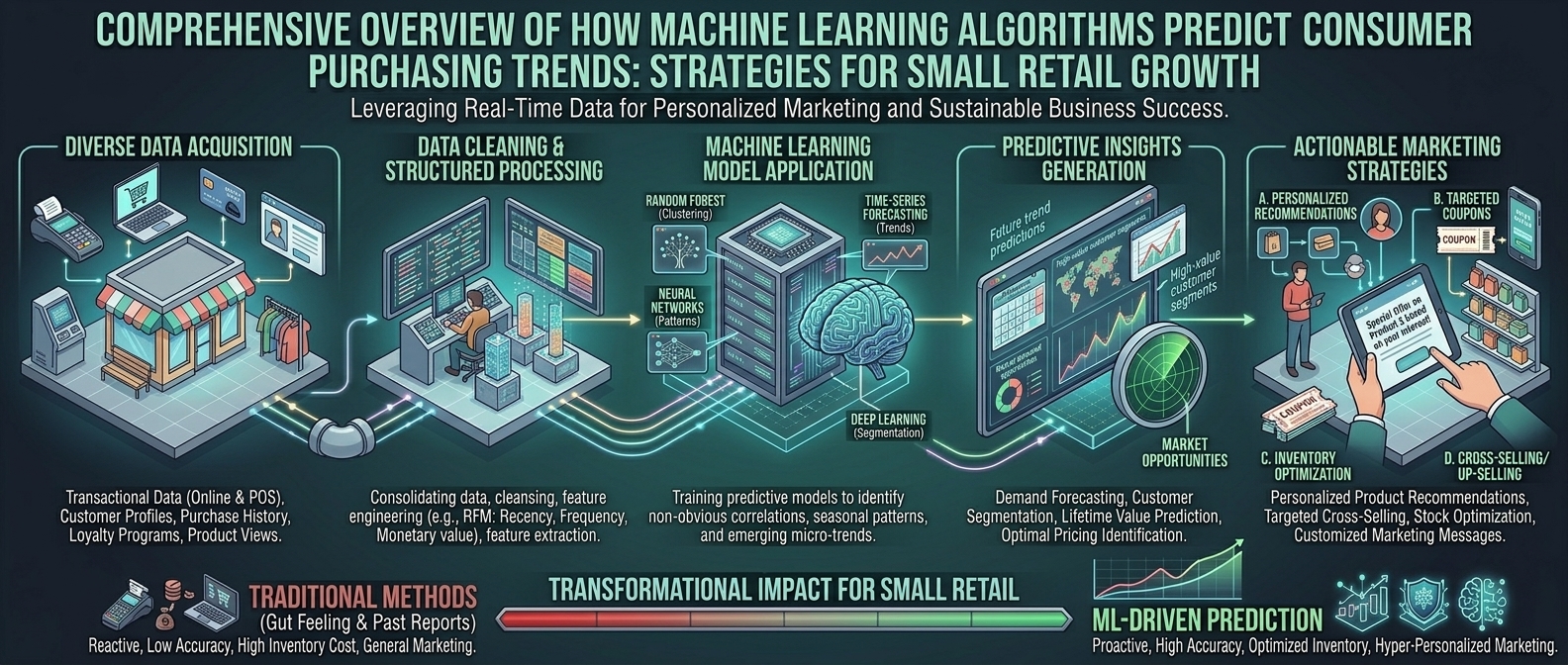
Comprehensive overview of how machine learning algorithms predict consumer purchasing trends for small retail marketing strategies
Introduction: The New Era of Predictive Small Retail Marketing
The modern retail environment has undergone an unprecedented transformation. For decades, small and mid-sized retail enterprises operating across major commercial epicenters—from the fast-paced fashion blocks of New York and tech-forward boutiques of San Francisco to the expanding storefront networks in Texas, Washington, and California—relied heavily on intuition, seasonal guesswork, and historical lagging indicators to stock shelves and plan marketing campaigns.
Today, that reactive model is obsolete. The proliferation of omnichannel touchpoints, digital point-of-sale (POS) systems, customer relationship management (CRM) software, and social commerce has created an avalanche of data. However, data alone is merely noise. The true differentiator for modern boutique operations and growing retail enterprises is the deployment of machine learning (ML) algorithms to transform raw data streams into forward-looking intelligence.
Published via rauz.ne, this comprehensive, authoritative guide explores how machine learning algorithms predict consumer purchasing trends, dissects the core mechanics of predictive analytics, and provides actionable frameworks for small retail enterprises looking to optimize their marketing strategies, stretch tight advertising budgets, and outmaneuver enterprise competition.
1. Demystifying Machine Learning in Retail: Beyond the Buzzwords
What is Machine Learning in a Retail Context?
At its core, machine learning is a subset of artificial intelligence (AI) focused on building applications that learn from data and improve their accuracy over time without being explicitly programmed for every single outcome. In retail, machine learning models ingest structured variables (e.g., transaction timestamps, SKU IDs, pricing tiers, customer zip codes) and unstructured inputs (e.g., social media sentiment, product reviews, local weather variations) to identify hidden patterns, correlations, and future probabilities.
Descriptive vs. Predictive vs. Prescriptive Analytics
To understand the value of machine learning, retail operators must distinguish between three tiers of analytics:
- Descriptive Analytics (What happened?): Reviewing last month’s sales ledger to see that wool sweaters sold out in your Seattle location.
- Predictive Analytics (What is likely to happen?): Utilizing machine learning to forecast that an unexpected early cold snap in Washington and Northern California next month will spike demand for outerwear by 34%.
- Prescriptive Analytics (What action should we take?): The algorithm automatically recommending a targeted Instagram ad campaign for wool sweaters directed at local subscribers who browsed cold-weather gear online, alongside an automated inventory reorder suggestion.
2. Core Machine Learning Models Driving Consumer Trend Predictions
Machine learning is not a single tool, but a suite of sophisticated algorithms designed for specific predictive tasks. Here are the primary model classes reshaping small retail marketing:
A. Regression Models for Continuous Forecasting
Regression algorithms (such as Linear Regression, Ridge, and Lasso) analyze the relationship between a dependent variable (e.g., sales volume) and independent variables (e.g., price, promotional discounts, local foot traffic, seasonal indexes). For a small apparel shop in San Francisco, regression models help predict exact sales trajectories when modifying product prices or introducing bundle discounts.
B. Classification Algorithms for Customer Segmentation
Classification models (such as Logistic Regression, Decision Trees, and Random Forests) sort consumers into predefined categories. In retail marketing, these algorithms evaluate buyer characteristics to predict whether a website visitor is a “window shopper,” a “bargain hunter,” or a “high-intent luxury buyer,” allowing the marketing engine to serve dynamic, hyper-relevant offers accordingly.
C. Clustering Algorithms for Behavioral Grouping
Unlike classification, clustering algorithms (such as K-Means or Hierarchical Clustering) do not rely on pre-existing labels. Instead, they group unlabelled customer data based on natural similarities in purchasing frequency, average order value (AOV), product preferences, and channel engagement. This enables localized boutique chains in Texas or New York to discover niche micro-segments they did not realize existed.
D. Deep Learning and Neural Networks for Sequence Prediction
Recurrent Neural Networks (RNNs) and Long Short-Term Memory (LSTM) networks excel at tracking sequences over time. They are vital for capturing shifting consumer trend cycles, seasonal nuances, and sudden market volatility driven by viral social media trends.
3. How Algorithms Predict Consumer Purchasing Trends Step-by-Step
Understanding how a machine learning pipeline functions demystifies the technology, moving it from a “black box” to an actionable operational asset.
[Data Ingestion (POS, CRM, Web)]
       ↓
[Data Cleaning & Feature Engineering]
       ↓
[ML Model Training & Validation]
       ↓
[Trend Prediction & Score Generation]
       ↓
[Automated Omnichannel Action (Ad Targeting, Inventory, Email)]
- Data Ingestion: Aggregating clean, multi-channel data sources including e-commerce clickstreams, mobile app interactions, in-store POS receipts, loyalty program logs, and external market indicators (e.g., regional economic indicators across California or holiday schedules).
- Feature Engineering: Translating raw data into meaningful variables—such as calculating “recency, frequency, monetary” (RFM) scores, identifying time-between-purchases, or mapping geographic clusters.
- Model Training: Feeding historical data into algorithms so they can “learn” what patterns preceded past purchasing surges or customer churn events.
- Prediction and Scoring: Running fresh consumer data through the trained model to output predictive scores (e.g., probability of purchase within 7 days, predicted churn risk score, or expected product demand volume).
- Automated Action Execution: Pushing these insights directly into marketing automation platforms (like Klaviyo, Meta Ads Manager, or Klaviyo) to trigger personalized SMS text messages, custom email flows, or targeted ad lookalike audiences.
4. Strategic Benefits for Small Retailers: Leveling the Playing Field
Historically, advanced predictive analytics were locked behind multi-million-dollar enterprise software budgets used exclusively by retail giants like Amazon or Walmart. Today, cloud-native SaaS platforms and accessible open-source libraries have democratized machine learning, offering profound advantages to lean, independent retail enterprises:
- Precision Budget Allocation: Instead of casting a wide, expensive net across social media advertising platforms, predictive marketing allows small retailers to target high-intent segments, dramatically lowering Customer Acquisition Cost (CAC) and maximizing Return on Ad Spend (ROAS).
- Mitigation of Inventory Waste and Dead Stock: Predictive trend algorithms align marketing promotions with actual inventory levels. If an algorithm predicts a drop in demand for a specific product category, automated clearance promotions can be triggered before the stock becomes obsolete dead weight.
- Maximized Customer Lifetime Value (LTV): By identifying behavioral patterns that precede customer drop-off, predictive models flag at-risk buyers, allowing marketing teams to deploy automated win-back campaigns and personalized incentives that boost retention.
5. Sector-Specific Applications Across Key U.S. Retail Hubs
Different commercial regions face unique consumer archetypes and operational pressures. Here is how predictive ML strategies adapt across markets:
- Boutique Fashion & E-Commerce (New York & San Francisco): High trend velocity and dense urban demographics require rapid trend forecasting. Machine learning models analyze social media micro-trends, visual search data, and runway cycles to predict which aesthetic styles will dominate upcoming seasons, ensuring local boutiques curate high-turnover inventories.
- Specialty Goods & General Retail (Texas): Sprawling geographic footprints and distinct regional preferences mean consumer behavior varies significantly between metropolitan centers like Austin, Dallas, and Houston versus rural outposts. Predictive clustering helps regional retailers tailor hyper-local email campaigns and localized inventory balancing.
- Lifestyle & Eco-Conscious Retail (Washington & California): Consumer demand is heavily influenced by sustainability metrics, ethical sourcing, and seasonal outdoor recreation habits. ML models process regional climate variations, local events, and consumer sentiment data to time outdoor gear and eco-friendly product promotions precisely when purchase intent peaks.
6. Implementation Challenges and Common Pitfalls for Small Businesses
While the upside is monumental, deploying machine learning for retail marketing is not without hurdles. Small business owners should navigate these common pitfalls with caution:
A. The “Garbage In, Garbage Out” Data Trap
- The Problem: Machine learning models are only as good as the data fed into them. Fragmented POS data, duplicate customer profiles, and missing transaction records lead to distorted predictions.
- The Fix: Invest time in foundational data hygiene. Consolidate customer records into a single Customer Data Platform (CDP) or unified CRM before layering complex predictive tools on top.
B. Over-Reliance on Automation Without Human Oversight
- The Problem: Letting algorithms completely dictate marketing messaging or pricing without human supervision can lead to tone-deaf automated campaigns during unexpected local or global events.
- The Fix: Maintain a “human-in-the-loop” framework. Use AI recommendations to guide strategy, but require manual sign-off for major promotional pushes or dynamic pricing shifts.
C. Ignoring Data Privacy Regulations
- The Problem: Predictive marketing relies heavily on tracking consumer behavior. Violating local data privacy laws (such as the California Consumer Privacy Act – CCPA) can result in severe financial penalties and brand erosion.
- The Fix: Implement transparent consent mechanisms, honor opt-out requests rigorously, and prioritize first-party data collection over invasive third-party tracking cookies.
7. Actionable Tips for Small Retailers Starting with Predictive Marketing
- Tip 1: Start Small with High-Impact Use Cases. Do not attempt to build a custom neural network from scratch. Begin with pre-built predictive features inside modern e-commerce platforms (like Shopify Audiences or built-in Klaviyo predictive churn analytics).
- Tip 2: Focus on First-Party Data Collection. Strengthen your email and SMS collection points at the POS and online checkouts. Clean first-party data is the highest-quality fuel for machine learning models.
- Tip 3: Segment Your Customer Base by RFM (Recency, Frequency, Monetary). Use basic clustering models to separate your top 10% VIP buyers from one-time purchasers, then tailor distinct marketing messages for each tier.
- Tip 4: A/B Test Algorithm-Driven Recommendations. Continuously test algorithm-generated product recommendations against standard best-sellers to measure the true revenue lift provided by your predictive tools.
- Tip 5: Sync Marketing with Inventory Visibility. Ensure your marketing team communicates closely with inventory managers. Never run aggressive predictive ad campaigns for products with low stock levels that risk immediate stockouts.
8. Frequently Asked Questions (FAQ)
1. What is machine learning in retail consumer trend prediction?
It is the use of automated algorithms that ingest historical sales, customer behavior, and external market data to forecast what products consumers will want to buy next and when they will buy them.
2. Do small retail businesses need a data scientist to use predictive analytics?
No. Modern retail software, e-commerce plugins, and marketing automation platforms come equipped with out-of-the-box machine learning tools that handle the complex mathematics behind the scenes.
3. What kind of data do machine learning algorithms need to predict trends?
Algorithms require clean historical transaction data, customer purchase frequency, website browsing behavior, product return rates, pricing history, and external variables like seasonality and local events.
4. How does predictive analytics improve retail marketing ROI?
By identifying which customers are most likely to convert, which leads have high purchase intent, and which products are gaining traction, retailers can focus their marketing budgets on high-yielding channels, eliminating wasted ad spend.
5. Can machine learning help prevent customer churn?
Yes. Predictive models analyze engagement drops and purchase intervals to flag customers who are losing interest, allowing marketers to automatically trigger retention discounts or win-back campaigns.
6. Is predictive analytics expensive for independent boutique owners?
Many scalable SaaS tools offer tiered pricing models tailored for small businesses, making predictive analytics cost-effective by generating immediate revenue lift that outweighs software subscription costs.
7. What is the difference between descriptive and predictive analytics in retail?
Descriptive analytics looks backward to report on what happened in past sales periods, while predictive analytics uses machine learning to forecast future consumer behavior and market trends.
8. How do algorithms handle sudden shifts in consumer trends?
Advanced machine learning models incorporate real-time data feeds (such as social media trends and live search queries) to sense rapid shifts in consumer demand and adapt forecasts dynamically.
9. Are there privacy concerns with using predictive consumer analytics?
Yes, retailers must comply with data privacy frameworks (such as the CCPA) by ensuring transparent data collection, securing customer information, and offering clear opt-out options.
10. How can a small retailer take their first step into predictive marketing?
Audit your current customer data quality, choose an e-commerce platform or CRM with built-in predictive analytics features, and run a targeted pilot campaign focused on customer re-engagement or personalized product recommendations.
Conclusion: Turning Predictive Insights into Retail Growth
The evolution of retail marketing has permanently shifted away from gut feeling toward data-backed precision. Machine learning algorithms are no longer exclusive tools for multinational retail conglomerates; they are accessible, powerful assets empowering small and mid-sized merchants across Texas, New York, California, Washington, and San Francisco to anticipate consumer desires before they materialize.
Leave a Reply