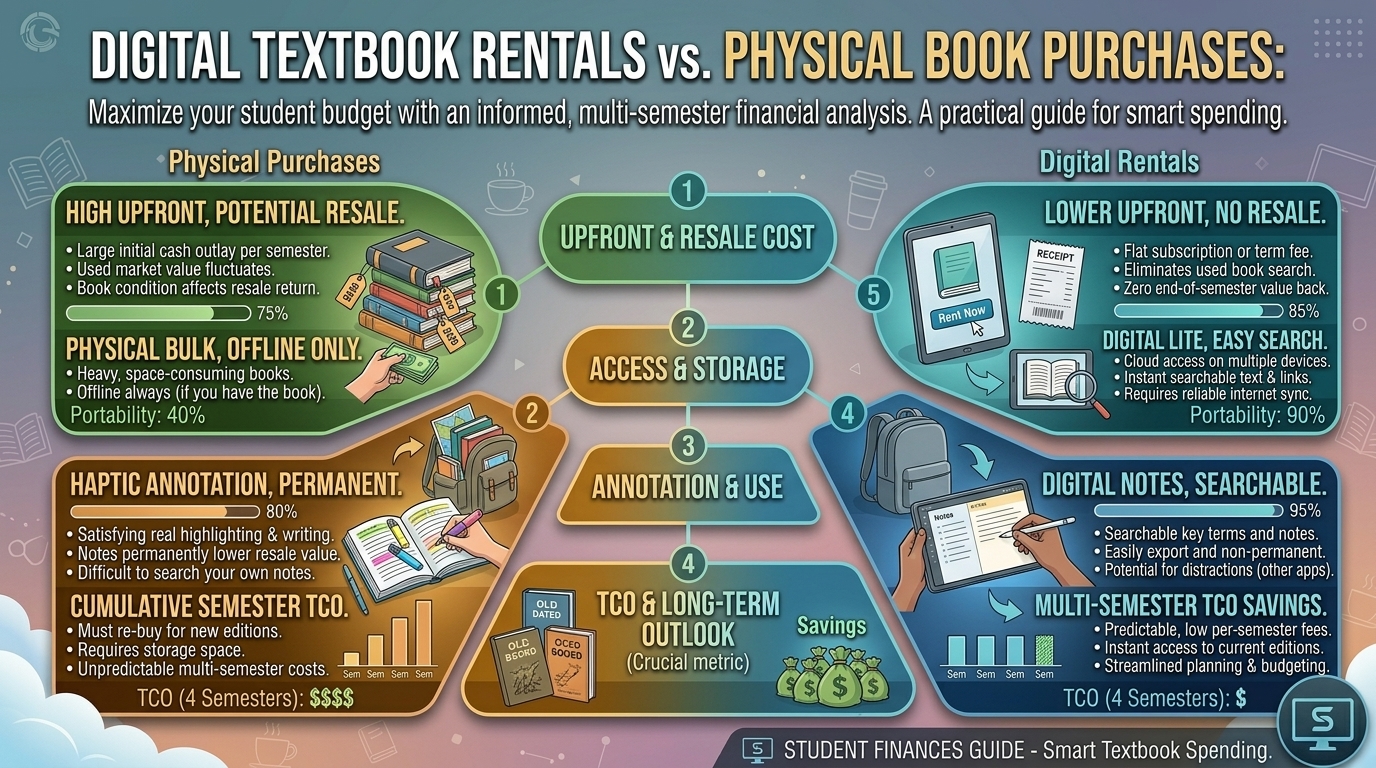
For university students navigating academic semesters across major educational and professional hubs—from tech and research campuses in San Francisco and Seattle (Washington), corporate and media centers in New York, innovation corridors in Austin (Texas), to diverse university systems across California—managing college expenses is a constant balancing act. While tuition and housing claim the lion’s share of student budgets, textbooks and course materials remain a stealth financial burden.
Historically, students faced an expensive binary choice: purchase heavy, brand-new physical textbooks at exorbitant bookstore prices or gamble on confusing used book markets. Today, the rise of digital textbook rental software and e-reader platforms has disrupted the traditional campus bookstore model.
At rauz.ne, we deliver an exhaustive, analytical cost-comparison between digital textbook rentals and traditional physical book purchases, breaking down long-term semester expenses, hidden fees, and financial optimization strategies.
Part 1: The Economics of Higher Education Publishing
To understand why digital rentals have gained massive market share, we must first analyze how the traditional textbook market functions and where student capital is lost.
+-------------------------------------------------------------------------------------------------+
|               TRADITIONAL PHYSICAL TEXTBOOKS VS. DIGITAL RENTAL ECONOMICS                       |
+-------------------------------------------------------------------------------------------------+
| Financial Metric      | Purchasing Physical Books            | Digital Textbook Rentals         |
+-----------------------+------------------------------------+------------------------------------+
| Initial Upfront Cost  | Extremely High ($150–$300 per book)| Low to Moderate ($30–$80 per term) |
| Resale / Buyback Value| Highly volatile (often 10%–20% back)| Zero (Access expires post-term)    |
| Shipping & Handling   | Often incurs bookstore/freight fees| Instant cloud delivery (Zero fees) |
| Edition Obsolescence  | High risk of holding worthless old editions| Avoided via time-bound rental access|
+-------------------------------------------------------------------------------------------------+
1. The Trap of the Rapid Edition Cycle
Academic publishers frequently release minor “new editions” of standard textbooks every two to three years, altering end-of-chapter problems just enough to render previous physical editions obsolete for homework assignments. When students purchase physical books outright, they take on 100% of the depreciation risk. If a professor switches editions the following semester, the resale value of that physical book plummets to near zero.
2. The Digital Rental Model Explained
Digital textbook rental software (offered by platforms like VitalSource, RedShelf, Chegg, and Kindle/Campus rentals) operates on a subscription or time-bound license model. Students pay a fraction of the retail price to access the digital textbook for a specific semester window (typically 120 to 180 days). Once the semester concludes, access expires, eliminating the hassle of reselling heavy books back to campus bookstores at a steep loss.
Part 2: Comprehensive Financial Breakdown Across a Four-Year Degree
To evaluate true long-term expense impacts, let us examine a standard semester course load requiring 5 textbooks averaging $175 each at retail value.
+-------------------------------------------------------------------------------------------------+
|                 FOUR-YEAR SEMESTER EXPENSE PROJECTION (5 COURSES/TERM)                          |
+-------------------------------------------------------------------------------------------------+
| Academic Term         | Outright Physical Purchase         | Digital Textbook Rental Model      |
+-----------------------+------------------------------------+------------------------------------+
| Freshman Year         | $1,750 (Zero recovery value)       | $450 (Digital rental licenses)     |
| Sophomore Year        | $1,600 (Minor buyback returns)     | $420 (Digital rental licenses)     |
| Junior Year           | $1,800 (Specialized upper-div books)| $500 (Advanced digital licensing)  |
| Senior Year           | $1,400 (Thesis / elective focus)   | $350 (Targeted software rentals)   |
+-----------------------+------------------------------------+------------------------------------+
| **4-Year Cumulative** | **$6,550 Total Spent**             | **$1,720 Total Spent**             |
+-------------------------------------------------------------------------------------------------+
1. The Immediate Upfront Savings
As illustrated above, purchasing five new physical textbooks per semester can easily cost upwards of $850 to $1,000 upfront. For students working part-time or managing tight budgets, pulling together $1,000 at the start of every term creates immediate cash-flow strain. Digital rentals slash upfront semester book costs by 60% to 75%, smoothing out financial pressure.
2. The Buyback Illusion
Proponents of physical books often argue that buying and reselling books mitigates the high initial cost. However, campus bookstore buyback programs are notoriously unfavorable to students. A textbook purchased for $200 at the start of autumn is frequently bought back for a mere $20 to $30 at winter break—if the bookstore is even buying back that specific edition. Digital rentals bypass the buyback illusion entirely by pricing the asset strictly for the duration of its useful life.
Part 3: Step-by-Step Strategic Framework for Semester Material Savings
+-----------------------------------------------------------------------+
|               SEMESTER MATERIAL BUDGETING PIPELINE                    |
+-----------------------------------------------------------------------+
| Step 1: Wait for Official Syllabus Distribution Before Buying         |
|       │                                                               |
|       ▼                                                               |
| Step 2: Cross-Check Institutional LMS Software (VitalSource / RedShelf)|
|       │                                                               |
|       ▼                                                               |
| Step 3: Compare Digital Rental Fees vs. Used Physical Market          |
|       │                                                               |
|       ▼                                                               |
| Step 4: Evaluate DRM Restrictions and Offline Reading Capabilities    |
+-----------------------------------------------------------------------+
- Leverage Inclusive Access and Equitable Programs: Many modern universities partner with digital software providers (such as VitalSource or RedShelf) to offer Inclusive Access or “Day One” digital programs. These automatically bundle deeply discounted digital textbook licenses into tuition or course fees, often reducing book costs by an additional 40% compared to open retail rates.
- Scrutinize Digital Rights Management (DRM) Restrictions: Not all digital rentals are created equal. Some software platforms place strict limits on how many pages you can print, whether you can copy-paste text for citation notes, or how many devices can sync your annotations. Always review software terms before renting.
- Account for Ergonomic and Cognitive Factors: While digital rentals win decisively on long-term financial expenses, students must weigh reading fatigue. For dense mathematical proofs or heavy legal text, some students prefer renting physical books or pairing digital readers with portable external monitors.
Part 10 Comprehensive FAQs
1. Are digital textbook rentals actually cheaper than buying used physical books?
In most cases, yes. While a heavily used physical book bought and successfully resold can occasionally rival rental pricing, digital rentals offer guaranteed low upfront costs without the risk of failed buybacks or damaged book penalties.
2. How long does access last when you rent a digital textbook?
Standard digital textbook rentals are licensed for a fixed term, usually 120 to 180 days (covering a standard semester or quarter), though some platforms offer 365-day extended rental options for year-long sequence courses.
3. What happens to my notes and highlights after a digital rental expires?
Most quality textbook software platforms (like VitalSource or RedShelf) securely store your cloud annotations and highlights in your user account profile, allowing you to access or export your notes even after the rental license expires.
4. Can I read digital textbook rentals offline without an internet connection?
Yes. Leading digital rental apps allow you to download textbooks directly to your laptop, tablet, or smartphone for fully offline reading during commutes or flights.
5. What are “Inclusive Access” or “First Day” textbook programs?
These are institutional partnerships where universities negotiate bulk wholesale discounts with digital publishers, delivering required e-textbooks directly through the campus learning management system (LMS) on the first day of class at deep discounts.
6. Are there hidden fees associated with digital textbook rentals?
Unlike physical book rentals—which can incur penalty fees if pages are torn or bindings are damaged—digital rentals have zero physical wear-and-tear fees, though expiring access means you cannot keep the book permanently.
7. Can I print pages from a digital textbook rental?
Printing capabilities depend on the publisher’s Digital Rights Management (DRM) policies. Most platforms permit printing limited page batches (e.g., 10–20 pages at a time) for study notes, but block mass printing of entire textbooks.
8. Which digital textbook software platforms are most widely used by universities?
The industry leaders powering campus digital distribution include VitalSource Bookshelf, RedShelf, Chegg Study, and proprietary platform integrations via Amazon Kindle Campus.
9. Do digital textbook rentals include access to online homework portals (like MyLab or Mastering)?
Sometimes, but buyers must be cautious. If a professor requires an interactive online homework code (e.g., Pearson MyLab), renting a standalone e-textbook may not include the mandatory access code, requiring a bundled purchase instead.
10. How much money can an average student save per year using digital rentals?
By switching from purchasing new physical textbooks to utilizing digital rentals and inclusive access software, students typically save between $500 to $1,000 annually on course materials.
Conclusion
Navigating the financial demands of higher education requires strategic resource management across every expense category. Whether you are balancing textbook costs while attending university in New York, San Francisco, Seattle, Austin, or Los Angeles, relying on traditional, inflated physical bookstore purchases is an outdated financial trap.
Leave a Reply