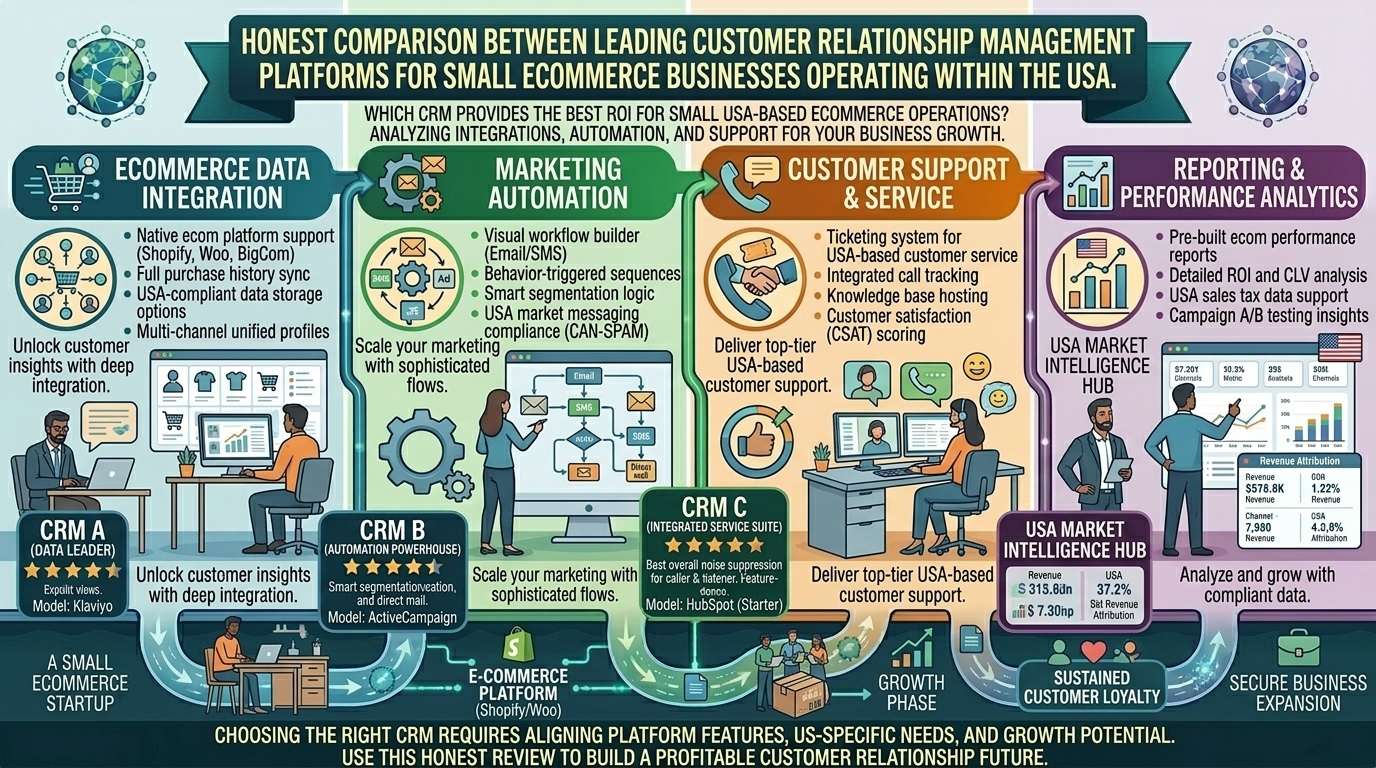
Honest Comparison Between Leading Customer Relationship Management Platforms for Small Ecommerce Businesses Operating Within the USA
Introduction: The Modern Ecommerce Landscape Across the United States
Running a small ecommerce business in the United States today is a high-stakes, hyper-competitive undertaking. Whether you are bootstrapping an innovative direct-to-consumer (DTC) brand out of a garage in Austin, Texas, scaling a boutique fashion label in New York, launching a sustainable goods startup in San Francisco or California, or managing a specialized tech-hardware store in Washington State, acquiring website traffic is only half the battle.
The real differentiator between stagnant online stores and hyper-profitable, long-term enterprises is customer retention, lifetime value (LTV), and data-driven personalization.
Traditional customer relationship management (CRM) software was built for B2B sales pipelines—tracking multi-month contracts, enterprise leads, and long sales cycles. However, small ecommerce businesses operate on a entirely different rhythm. You deal with high-volume transactional data, abandoned carts, rapid purchase cycles, multi-channel customer service tickets, and automated email/SMS marketing triggers.
This honest, comprehensive comparison evaluates the leading CRM and customer data platforms built specifically to help small-to-midsize ecommerce businesses thrive within the U.S. market.
Why Standard CRMs Fail Small Ecommerce Businesses
Before reviewing the top contenders, it is vital to understand why plugging a standard B2B sales CRM into an online store usually results in wasted capital and friction:
- The Transactional Volume Gap: B2B CRMs track dozens of deals per month; ecommerce stores process hundreds or thousands of automated orders daily. Manual data entry is impossible.
- Lack of Native Behavioral Tracking: Ecommerce requires tracking what products a user views, abandons in their cart, purchases, and returns, rather than just tracking phone calls and meeting notes.
- Marketing Automation Integration: A true ecommerce CRM must seamlessly integrate with email, SMS, loyalty rewards, and customer service helpdesks.
Evaluation Criteria: How We Ranked the Platforms
To ensure absolute neutrality and practical utility for rauz.ne, our evaluation metrics focus strictly on what matters to American online retailers:
- Ecommerce Platform Integration Depth: How cleanly does the CRM sync with Shopify, WooCommerce, BigCommerce, or Wix?
- Behavioral Segmentation & Data Depth: Can you segment buyers based on purchase history, average order value (AOV), and lifecycle stage?
- Omnichannel Marketing (Email & SMS): Can the platform execute automated abandoned cart flows, win-back sequences, and post-purchase follow-ups?
- Customer Support and Helpdesk Fusion: Does it bridge marketing data with customer service management (CSM)?
- Cost-to-Value & Scalability: Transparent pricing tiers that don’t punish a growing store the moment order volume spikes.
The Top 6 Ecommerce CRM & Marketing Platforms Compared
1. Klaviyo — Best for Data-Driven Email, SMS, and Lifecycle Automation
For the vast majority of modern Shopify and BigCommerce merchants across the U.S., Klaviyo has become the undisputed baseline standard for ecommerce customer relationship management. While technically positioned as a marketing automation and customer data platform (CDP), it functions as the ultimate ecommerce CRM.
Core Strengths
- Unmatched Data Sync: Pulls every historical data point from your store—down to exact product variants purchased, discount codes used, and site browsing behavior.
- Predictive Analytics: Automatically calculates customer lifetime value (LTV), predicted churn dates, and optimal send times using built-in machine learning models.
- Advanced Flow Builder: Build hyper-targeted automated sequences for browse abandonment, checkout drop-offs, and VIP loyalty milestones.
Pros & Cons
- Pros: Deepest ecommerce integrations on the market; incredibly powerful segmentation; exceptional revenue-attribution reporting.
- Cons: Pricing scales steeply as your contact list grows; interface has a learning curve for beginners.
2. HubSpot CRM (with Ecommerce Hub) — Best All-in-One Growth Platform
If your small business combines an online ecommerce store with B2B wholesale, custom manufacturing, or service consultations, HubSpot provides a comprehensive ecosystem that unifies everything under one roof.
Core Strengths
- Complete Business Suite: Combines marketing, sales pipelines, ticketing customer service, and CMS website tools into a unified database.
- Robust Free Tier: Excellent entry point for micro-businesses looking to organize contact lists without immediate overhead.
- Extensive App Marketplace: Connects easily with custom web apps, ERPs, and accounting tools like QuickBooks.
Pros & Cons
- Pros: Highly intuitive interface; brilliant customer support; scales seamlessly from startup to enterprise.
- Cons: Can become very expensive as you unlock advanced automation tiers; not natively optimized out-of-the-box for pure high-volume retail transactions compared to Klaviyo.
3. ActiveCampaign — Best for Visual Automation and Multi-Channel Journeys
For growth-focused online merchants in competitive markets like New York and California who want granular control over customer journeys across email, SMS, and site messaging, ActiveCampaign offers elite workflow architecture.
Core Strengths
- Visual Automation Builder: Easily map out complex branching paths based on how customers interact with your emails and website.
- Built-in CRM & Lead Scoring: Automatically score customers based on purchase frequency and engagement to identify brand advocates.
- Dynamic Content: Personalize email blocks dynamically based on past purchase history or geographic location.
Pros & Cons
- Pros: Highly visual and flexible automation builder; excellent deliverability rates; robust contact management.
- Cons: Native ecommerce reporting is slightly less granular than dedicated CDPs; managing heavy lists requires careful tagging hygiene.
4. Gorgias — Best for Customer Support-Centric Ecommerce CRMs
In ecommerce, customer service is sales. If your small business is drowning in “Where is my order?” (WISMO) tickets, returns inquiries, and pre-sale questions, Gorgias turns your helpdesk into a powerful revenue-generating CRM.
Core Strengths
- Unified Ticket & Order View: When a customer emails support, Gorgias instantly displays their entire Shopify/Magento order history, tracking numbers, and lifetime spend right next to the message.
- Revenue Attribution Tracking: Support agents can recommend upsells or apply discount codes directly inside chat windows, tracking exact revenue generated by support staff.
- Automated Macros: Instantly resolve routine inquiries with AI-assisted macros and self-service portals.
Pros & Cons
- Pros: The absolute best helpdesk CRM fusion for retail; saves countless hours of support team bandwidth.
- Cons: Priced based on ticket volume rather than contact counts, which can spike during holiday shopping seasons; limited traditional email marketing features.
5. Brevo (formerly Sendinblue) — Best Budget-Friendly All-in-One Option
For bootstrapped startups and micro-ecommerce owners operating on tight overhead across Texas or Washington, Brevo offers a remarkably robust, cost-effective alternative to high-priced American SaaS platforms.
Core Strengths
- Volume-Based Pricing: Unlike competitors that charge based on the total number of contacts in your database, Brevo primarily charges based on the number of emails sent, making large dormant subscriber lists cheap to maintain.
- Multi-Channel Outbox: Combines email marketing, SMS campaigns, WhatsApp business messaging, and a lightweight CRM pipeline.
- Clean Interface: Straightforward setup that doesn’t require a dedicated developer.
Pros & Cons
- Pros: Highly affordable entry and scaling costs; excellent transactional email delivery; built-in live chat tools.
- Cons: Advanced ecommerce segmentation and predictive metrics are less sophisticated than Klaviyo.
6. Omnisend — Best Rapid-Setup Solution for Shopify & WooCommerce Brands
Designed specifically with direct-to-consumer (DTC) ecommerce brands in mind, Omnisend bridges email and SMS marketing with easy-to-deploy prebuilt automation templates.
Core Strengths
- Prebuilt Ecommerce Workflows: Launch abandoned cart, welcome series, and shipping confirmation workflows in minutes using drag-and-drop templates.
- Combined Email & SMS: Manage both channels inside a single workflow step to maximize conversion rates.
- Product Picker Integration: Easily pull products directly from your store catalog straight into your email layouts with live pricing.
Pros & Cons
- Pros: Extremely fast onboarding; great balance of email and SMS; responsive customer support.
- Cons: Deep custom data segmentation options are somewhat restricted compared to enterprise-grade alternatives.
Comparison Matrix: Ecommerce CRM Platforms at a Glance
| Platform | Best For | Primary Focus | Pricing Structure | Top Integration |
| Klaviyo | Data-driven DTC brands | Email, SMS & Predictive LTV | Contact-tier based | Shopify, BigCommerce |
| HubSpot | Omnichannel & B2B/Retail | All-in-one Growth & Sales | Per-user / Tiered | Universal / Custom API |
| ActiveCampaign | Complex customer journeys | Visual Automation & CRM | Contact-tier based | WooCommerce, Shopify |
| Gorgias | Support-driven retail | Customer Service & Ticketing | Ticket-volume based | Shopify, Magento |
| Brevo | Cost-conscious startups | Affordable Email & SMS | Email-volume based | WooCommerce, Shopware |
| Omnisend | Fast setup for DTC stores | Prebuilt Retail Workflows | Contact-tier based | Shopify, WooCommerce |
Strategic Tips for Implementing an Ecommerce CRM
Choosing the software is only the first step. To extract maximum ROI from your CRM investment, adhere to these proven operational guidelines:
- Clean Your Data Early: Ensure your checkout fields capture clean first names, phone numbers (with explicit SMS consent compliant with TCPA regulations), and accurate location data. Dirty data destroys automation accuracy.
- Prioritize Lifecycle Milestones: Don’t just spam your list with daily promotional discounts. Focus your automated flows on three critical pillars: the Welcome Series (brand storytelling), the Abandoned Cart Recovery (friction reduction), and the Post-Purchase Review Request (social proof generation).
- Segment by Purchasing Behavior: Stop treating your entire subscriber list the same way. Separate one-time buyers from VIP repeat customers, and target them with tailored product recommendations based on past category affinity.
- Monitor Deliverability Relentlessly: Protect your sender reputation by regularly cleaning unengaged subscribers who haven’t opened an email in 90+ days. Land in the spam folder, and your revenue drops instantly.
10 Frequently Asked Questions (FAQs)
1. What is the difference between a traditional B2B CRM and an ecommerce CRM?
Traditional B2B CRMs (like Salesforce or basic Pipedrive) are designed to track long sales cycles, human-to-human negotiations, and deal pipelines. Ecommerce CRMs (or marketing automation platforms like Klaviyo and Omnisend) focus on automated, high-volume transactional data, browsing behavior, cart abandonments, and automated customer segmentation.
2. Do I need a CRM if I already use Shopify or WooCommerce?
While Shopify and WooCommerce have built-in basic notifications (like order confirmations and basic receipts), they lack advanced behavioral segmentation, predictive lifetime value analytics, multi-channel SMS automation, and detailed customer service ticketing histories. A dedicated CRM bridges these gaps to maximize repeat purchases.
3. Which ecommerce CRM is best for a brand just starting out on a tight budget?
For lean startups, Brevo or the free tiers of HubSpot and Omnisend provide excellent entry points without imposing heavy upfront software costs before you have established steady revenue streams.
4. Is Klaviyo worth the higher price tag for small stores?
Yes, if your business relies heavily on email and SMS marketing revenue. Klaviyo’s ability to track precise item-level data and attribute exact revenue to automated flows typically yields an ROI that far outweighs its subscription cost for active stores.
5. How do these platforms handle U.S. SMS compliance (TCPA and CTIA regulations)?
Platforms like Klaviyo, Omnisend, and ActiveCampaign feature built-in compliant consent checkboxes for checkout and popup forms. However, store owners must ensure they explicitly collect proper legal opt-ins before firing automated marketing texts to U.S. consumers.
6. Can customer service software act as a CRM for an online store?
Yes. Platforms like Gorgias blur the line between support and CRM by displaying complete customer order profiles, lifetime spends, and tracking details directly inside the helpdesk interface, allowing support agents to function as revenue generators.
7. How much customer data should I store before implementing a CRM?
You should implement a CRM from day one of launching your store. Capturing customer preferences, source acquisition channels, and behavioral history from your very first transaction prevents data silos as your business scales.
8. Can I connect these CRMs to physical retail POS systems as well?
Many top platforms (such as Klaviyo and Shopify-native tools) allow you to sync in-store POS data alongside online purchases, giving your business a unified omnichannel view of your customers whether they buy online or in a brick-and-mortar storefront.
9. What metrics matter most when measuring ecommerce CRM success?
Key performance indicators include Repeat Purchase Rate (RPR), Customer Lifetime Value (LTV), Email/SMS Revenue Percentage (the share of total store revenue driven by automated flows), and Cart Abandonment Recovery Rate.
10. How difficult is it to migrate customer data from one CRM to another later?
Migrating basic contact lists and historical purchase CSVs is generally straightforward. However, rebuilding complex multi-step automated workflows, custom tags, and tracking event scripts requires careful planning to prevent disruption during peak sales seasons.
Conclusion
Selecting the ideal customer relationship management platform for your small ecommerce business is a pivotal strategic choice. Whether you prioritize deep predictive data analytics with Klaviyo, all-in-one operational growth with HubSpot, advanced visual automation with ActiveCampaign, or support-driven revenue recovery with Gorgias, your platform must align with your unique product catalog and growth velocity.
Leave a Reply